- Mighty Consumer Notes
- Posts
- Can a Pandemic Side Hustle Become the Next National Chain? PopUp Bagels' 300-Location Bet
Can a Pandemic Side Hustle Become the Next National Chain? PopUp Bagels' 300-Location Bet
Can the viral bagel shop execute a national expansion plan?

Philip Wolf
October 29, 2025
The Expansion Question
Pop Up Bagels just announced one of the most ambitious franchise commitments in recent restaurant history: 300 locations across 10 states over the next 2-3 years. This expansion would be an exceptional outcome for a concept that started in founder Adam Goldberg's Connecticut backyard as a pandemic project. PopUp currently has 15 locations and projects to hit 100 locations by the end of 2027.
Going from 15 to 300 locations represents a 20x growth trajectory in just a few years. To put this in perspective, most emerging QSR brands consider doubling their footprint to be aggressive. Pop Up is aiming for a 20-fold increase while maintaining product quality in a notoriously finicky category—fresh bagels.
The question is twofold: 1) Can PopUp scale? 2) Can PopUp scale without becoming just another mediocre bagel chain. The restaurant graveyard is filled with beloved local concepts that expanded too fast, lost their magic and became cautionary tales such as Wawa and Dutch Bros.
The Pop Up Business Model and the Magic
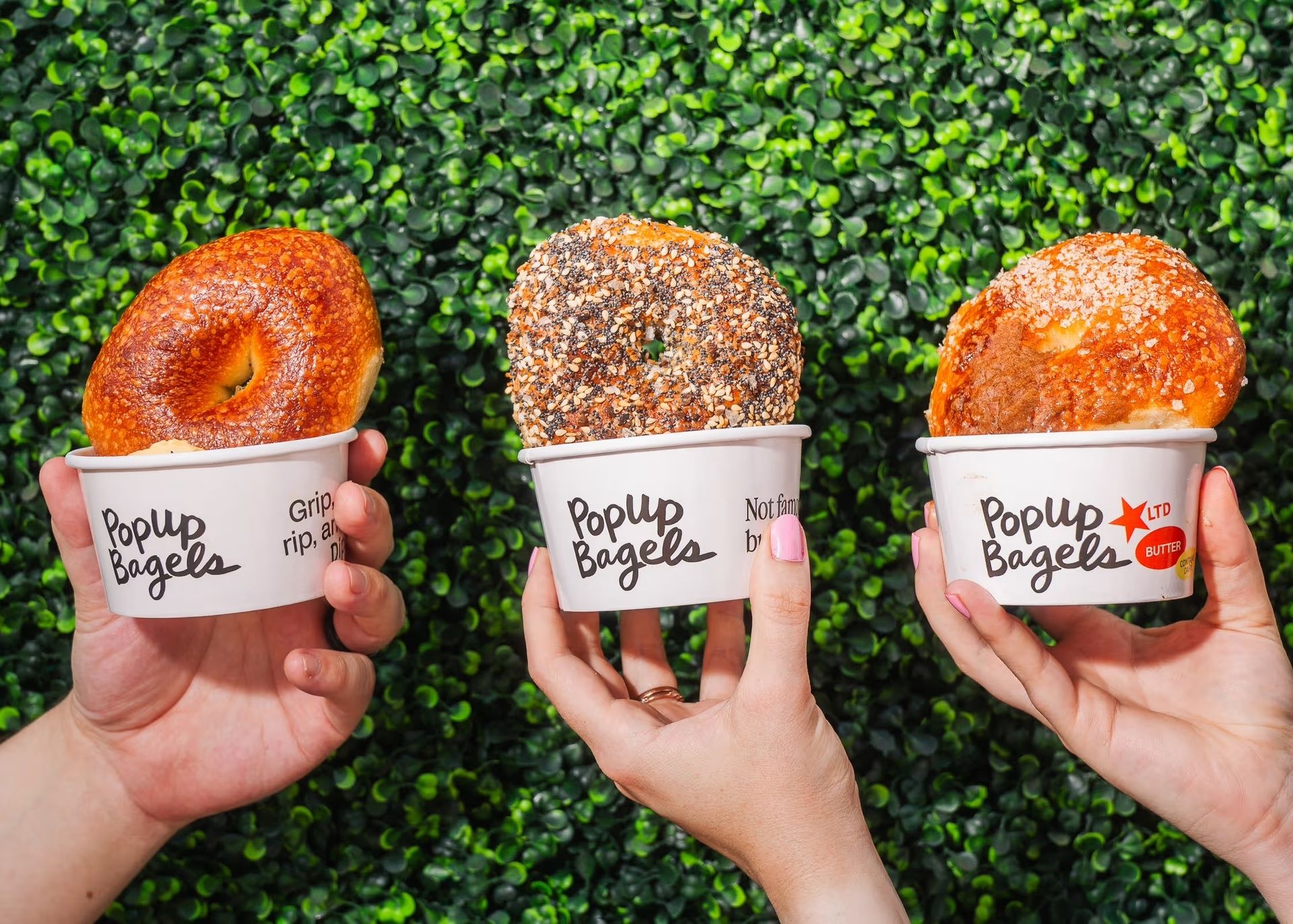
To understand Pop Up Bagels, we must examine the brand's magic to this point. PopUp has redefined bagel shop efficiency and social media virality as applied to bagels.
The model is elegantly simple:
Hot, unsliced bagels only: No sandwiches, no slicing, no toasting. Bagels come straight from the oven to the customer.
"Grip, Rip and Dip" ritual: Customers tear the bagel apart and dip into containers of cream cheese. It's tactile, visual, and perfect for social media content.
Three-bagel minimum order: This isn't arbitrary; it drives higher ticket sizes and forces customers to try multiple flavors, increasing engagement with the brand.
Mandatory smear purchase: Every order includes schmear (a cream cheese or flavored butter), ensuring consistent brand experience and boosting average check.
Streamlined Menu: Everything: sesame, poppy, salt, and plain.
3-pack with schmear for $12, a 6-pack for $18, or a 12-pack with add-ons for $42. It's baked into the model. Extra schmear is $7.
The simplified operations: No sandwich assembly, no slicing, no toasting—means significantly faster throughput. More customers in, more customers out, which is critical for small-footprint stores that need high volume to justify prime real estate costs.
Store Economics
PopUp Bagels keeps a light footprint with small stores typically ranging700 to 1,200 square feet. This compact footprint drives efficiency. Less space means lower rent and build-out costs. PopUp's takeout-focused model eliminates the need for seating.
By packing high demand into small spaces, PopUp Bagels generates significantly more revenue per square foot than traditional bagel shops or sit-down restaurants. For example, if a high-performing PopUp location is doing $5 million annually in roughly 1,000 square feet, that's $5,000 per square foot—dramatically higher than industry benchmarks. The average quick-service restaurant generates around $600-$800 per square foot, while even strong fast-casual concepts typically hit $1,000-$1,500. PopUp Bagels is operating at 3-5x those levels.
Strategic Franchise Structure
Pop Up has reached 300 signed locations with just 15 franchise partners—an average of 20 units per operator. This is sophisticated: rather than selling single-unit franchises to hundreds of inexperienced operators, they're partnering with "best-in-class" multi-unit restaurant veterans. James Marzouk of Sweetzer Capital is developing 25 locations in LA and Orange County alone.
The Case Against Expansion
The central question facing Pop Up Bagels isn't whether it can open stores. It's whether the model can transition from novelty to routine. Are the long lines driven by one-time buyers chasing social media buzz and driven by limited-location scarcity? Or can PopUp can create genuine repeat customers who integrate these bagels into their daily habits as the chain scales from 15 to 300 locations? (more than Sweetgreen)
Destination concepts thrive on exclusivity and limited access. Customers will wait an hour for something rare, once. However, neighborhood bagel shops require the opposite: reliable, frequent transactions from locals who stop by multiple times per week. Pop Up's current demand may reflect novelty and scarcity rather than sustainable daily usage, and several structural elements could prevent habit formation at scale:
1. Mandatory Cream Cheese Policy. The forced schmear purchase works in the context of a novel one-time experience, but could be a challenge for customers to incorporate into a weekly or bi-weekly routine. To write this article, I visited PopUp three times. I now have three half-eaten tubs of shmear taking up valuable real estate in my small apartment fridge.
2. No Single-Serving Option. Pop Up's three-bagel minimum create a challenge for a solo shopper. A customer wanting breakfast on the way to work can't buy one bagel sandwich; they must purchase three bagels plus schmear.
3. Cold Bagels. Pop Up's value proposition centers on "hot from the oven." The dough and product are designed to taste great steamy hot. However, it is commonly noted in online food communities that the consistency and flavor of the bagel is lacking at room temperature. This limits the use case for shoppers.
Quality Control at Scale. Bagel production requires precision—dough proofing, water chemistry, baking temperature. Small variations produce inconsistent results bagels.
If Pop Up remains a novelty that customers visit once or twice for the experience, 300 locations will oversaturate demand. If it becomes a weekly or daily habit, the economics work. The challenge is that several core model elements: mandatory purchases, minimum quantities, cold product issues, seem designed for the former, not the latter.
Why Everyone's Getting the Comp Wrong
When commentators like the Morning Brew Daily’s Neil and Toby debate Pop Up's expansion potential, they inevitably point to Einstein Bros. as the main comparable. This is logical since Einstein Bros, with 700+ locations, is the largest national bagel chain.
However, this comparison is fundamentally wrong. Einstein Bros. is not a highly accurate comp for Pop Up Bagels: While both sell bagels, the product and experience are distinctly different.
To really assess PopUp Bagels' growth capacity, we must look at it as the Raising Cane's of bagels. For those unfamiliar, Raising Cane's is a chicken finger chain that built a cult following with an extremely limited menu: essentially chicken fingers, fries, toast, and signature sauce. The chain mastered operational simplicity and quality consistency, expanding from a single Louisiana location in 1996 to over 700 units today with $3.7 billion in annual sales, proving that menu constraint paired with execution excellence can scale dramatically.
Here's how PopUp and Raising Cane’s compare:
1. Founder DNA: Obsessive Product Perfection
Adam Goldberg and Todd Graves are cut from the same cloth. Both founders spent years perfecting a single product before scaling:
Goldberg started baking bagels in his backyard during the pandemic, iterating on dough recipes, proofing times, and baking temperatures until he created what BagelFest called the best bagel in Brooklyn two years running. He didn't rush to market. Instead, he obsessed over the product.
Graves received the lowest grade in his LSU business class when he proposed a restaurant serving only chicken fingers. His professor told him "you really didn't do your homework" and warned that such a limited menu would doom him. Graves worked as an oil refinery boilermaker and Alaskan salmon fisherman to fund his vision, opened in 1996, and spent years perfecting the chicken-and-sauce combination before expanding.
2. Ruthlessly Streamlined Operations
This is where the Einstein Bros. comparison completely falls apart. Einstein Bros. is a traditional bagel shop: sandwiches, slicing, toasting, salads, and complicated breakfast builds. Pop Up and Raising Cane's are the opposite; they are powered by simplicity:
Raising Cane's: Just five items: chicken fingers, crinkle-cut fries, Texas toast, coleslaw, and Cane's sauce. Pop Up Bagels: Just bagels and schmear, no sandwiches, no slicing, no toasting. Customers order three bagels minimum with mandatory cream cheese, grip them hot, rip them apart, and dip. That's it. Both faced industry skepticism about their "too narrow" concepts. Both proved that doing one thing perfectly beats doing many things adequately. Both businesses rely on high traffic areas and push customers through.
3. The Secret is in the Sauce (or Schmear).
Both concepts have turned their "dippable" element into cult obsessions:
Cane's Sauce: Graves describes it as "the hook"—the chicken is excellent, but with the sauce, "that's the craveable part." The sauce's cult following drives traffic and creates brand evangelists. Pop Up's Schmears: Rotating collaborations with chefs, tastemakers, and brands create limited-edition cream cheese flavors that drive social media buzz and repeat visits. The mandatory cream cheese purchase ensures every customer experiences the "Rip and Dip" ritual, creating a consistent brand interaction.
4. Culture of Happy Employees
This might be the most important parallel:
Raising Cane's: Voted Top Workplace USA 2024 (only restaurant in top 25). Culture is so central that every corporate employee—from accountants to tech support—must work as fry cooks and cashiers for at least two weeks. Pop Up Bagels: PopUp Bagels' team was similar. In a conversation with Brandon, a sous chef at Pop Up's Upper West Side location, Brandon said, “I genuinely love coming to work here. Before PopUp bagels I worked at all kinds of restaurants from Thai, to Mediterranean, to American-style diners. PopUp is different. Normally, chefs have no relationship with their customers. Here, I get to interact with people and see their enjoyment as they tear into steaming bagels. Our team gets to have fun.
PopUp looks more like a Raising Cane's with bagels. The playbook is identical: obsessive product focus, streamlined operations, dippable differentiation, and culture-first scaling.
Can PopUp Scale?
Returning to our three questions: - 1-Can PopUp scale. 2) Can PopUp scale without becoming just another mediocre bagel chain. 3- Can the rip and dip experience become a ritual for consumers across the country?
1) Yes. From talking to Brandon, who trains new franchise owners at the Upper West Side location, the PUB formula is easy. New owners “can do it in their sleep.” Each location requires minimal space and overhead.
2) Yes. Bagels have minimal ingredients. As long as franchisees learn their system, the quality will be there. If Shake Shack and Chipotle can do it, PUB can too.
3- I’m 75% confident. Pop Up Bagels is a high-energy, social experience. Americans love dipping: Chips and guac, pita and hummus, wings in ranch, the list goes on. So, bagels are not a wild next step. There is a symphony of the smell of fresh bagels, the banging of sheet trays as bagels are poured into serving bins, and the joyous declaration of “hot bagels” by team members. Further, when the product is enjoyed as intended, it’s great, and it keeps me coming back.